FUE Hair Transplant in Dallas, TX, by Dr. Sam Lam
Advanced follicular unit excision performed by a globally recognized FUE authority.
For patients considering follicular unit excision (FUE) in Dallas, few surgeons bring the depth of expertise that Dr. Sam Lam offers at the Lam Institute for Hair Restoration. As the author of the only multi-volume FUE textbook in existence and an international educator who has trained surgeons across the United States, Asia, Europe, and beyond, Dr. Lam performs every step of every procedure himself — no technicians, no delegation, no exceptions.
What Is FUE?
FUE is a minimally invasive hair transplant method in which individual follicular units are harvested one at a time from the donor area using precision micro-punches smaller than one millimeter. These grafts are then placed into recipient sites across thinning or balding areas, where they grow permanently. Because FUE leaves no linear incision, it appeals to patients who prefer wearing their hair short or simply want to avoid a visible scar on the back of the head. Results are permanent, natural-looking, and indistinguishable from the surrounding hair once fully grown.
Dr. Lam’s Advanced Approach to FUE Hair Transplantation
Dr. Lam exclusively uses hybrid FUE technology — a significant advancement over older blunt- and sharp-punch systems that dominated the field before 2017. Hybrid punches combine a sharp outer edge that cleanly cuts tissue with a blunt inner funnel that shields the graft, dramatically reducing transection rates and producing healthier, more viable grafts than prior generations of FUE equipment. His 2022 two-volume textbook was written specifically to document this technological evolution.
Beyond equipment, Dr. Lam’s results are defined by surgical artistry. He personally designs every hairline, paying close attention to age, facial structure, ethnicity, and long-term hair loss trajectory. Graft placement is executed with precise angulation, directional control, and careful matching of graft size to recipient site — details that separate natural-looking outcomes from detectable ones. With more than 20 years of FUE experience, Dr. Lam also performs a high volume of corrective work for patients who received suboptimal results elsewhere, including overharvested donor areas, improperly designed hairlines, and poorly placed grafts.
FUE vs. FUT and Other Hair Restoration Options
FUE and FUT (strip) are not interchangeable — each is suited to a different type of patient. FUE leaves no linear scar and allows for a shorter recovery, making it ideal for men who wear their hair close to the scalp. FUT, however, harvests from the densest area of the donor zone and does not reduce overall donor volume, which makes it the superior choice for women and men with advanced hair loss. Dr. Lam performs both techniques and selects one based on your specific anatomy and goals.
Is FUE Right for You?
FUE is best suited for men with early to moderate hair loss who prefer a shorter hairstyle, have stable donor density, and want to avoid a linear scar. It is also appropriate for men requiring beard-to-scalp grafting when donor supply is limited.
FUE is generally not recommended for women, as it requires shaving the donor area and reduces the density of the back of the scalp — a result most female patients find unacceptable. Dr. Lam declines to perform FUE on patients who are not appropriate candidates, regardless of their preference.
FUE Hair Transplant Results From Dallas Patients


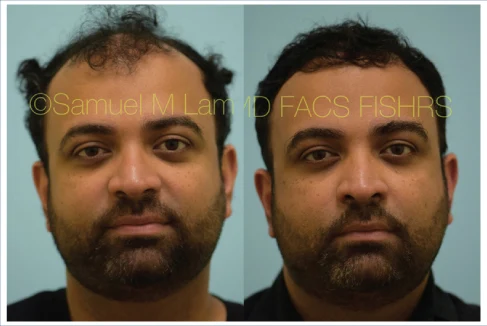

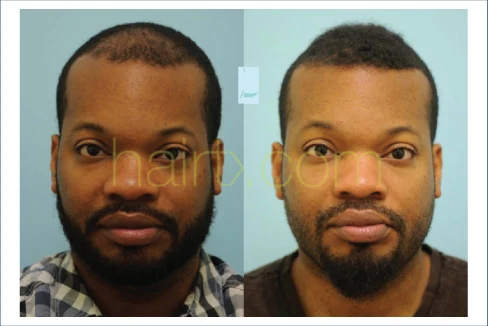

Dr. Lam’s results are documented across hundreds of before-and-after cases spanning men of every ethnicity, hair type, and degree of hair loss. His outcomes are evaluated not only at a distance but under close inspection — a standard he holds himself to regardless of graft count. Natural density, seamless hairline transitions, and correct hair directionality are consistent markers of his work.
FUE Hair Transplant Process & Recovery
Procedure Day
FUE at the Lam Institute for Hair Restoration is performed under IV sedation in our Joint Commission-accredited facility. Patients are comfortable throughout the 8-10 hour procedure and consistently report being surprised by how quickly the day has passed. Dr. Lam handles all harvesting personally from start to finish.
Healing & Shedding Phase
Small scabs form around the transplanted and donor sites but resolve within about seven days. Some patients experience mild forehead swelling in the first few days. Light activities can resume within 48 hours, and most patients return to work after about a week.
Hair Growth Timeline
Transplanted hairs typically shed in the first few weeks before entering the growth phase. Initial growth may appear as early as four to six months, with full density typically visible at 12 months and occasional continued improvement up to 18 months.
FUE Hair Transplant Cost in Dallas
Dr. Lam does not charge per graft. His FUE fees are structured by case complexity and reflect over two decades of surgical expertise, advanced hybrid technology, full IV sedation, and a surgeon-only approach that is uncommon in today’s market. Pricing is discussed in detail during your consultation.
FUE Hair Transplant FAQs – Dallas
-
How long does FUE take?
The procedure runs approximately 8 to 10 hours from start to finish. IV sedation ensures that time passes comfortably for the patient.
-
Is FUE permanent?
Yes. Transplanted follicles retain the genetic characteristics of the donor area and are not subject to the same pattern hair loss affecting the recipient zone. The effects are intended to be lifelong.
-
How soon can I return to work?
Most patients resume light work within a few days and are fully socially presentable in one week.
Schedule Your FUE Hair Transplant Consultation in Dallas
To find out whether FUE is the right approach for your hair loss, contact the Lam Institute for Hair Restoration in Dallas to schedule a personal consultation with Dr. Sam Lam. He will evaluate your donor density, hair loss pattern, and long-term goals to determine the safest and most effective path forward.
over 6000 before & afters